
 Contact

Mary Girouard
Written By: Julia Brabant, September, 2026Mary Girouard Spent Years Fundraising to Fight Cancer Before the Mission Became Personal
Mary Girouard rode thousands of miles in the fight against cancer before she ever faced it herself.
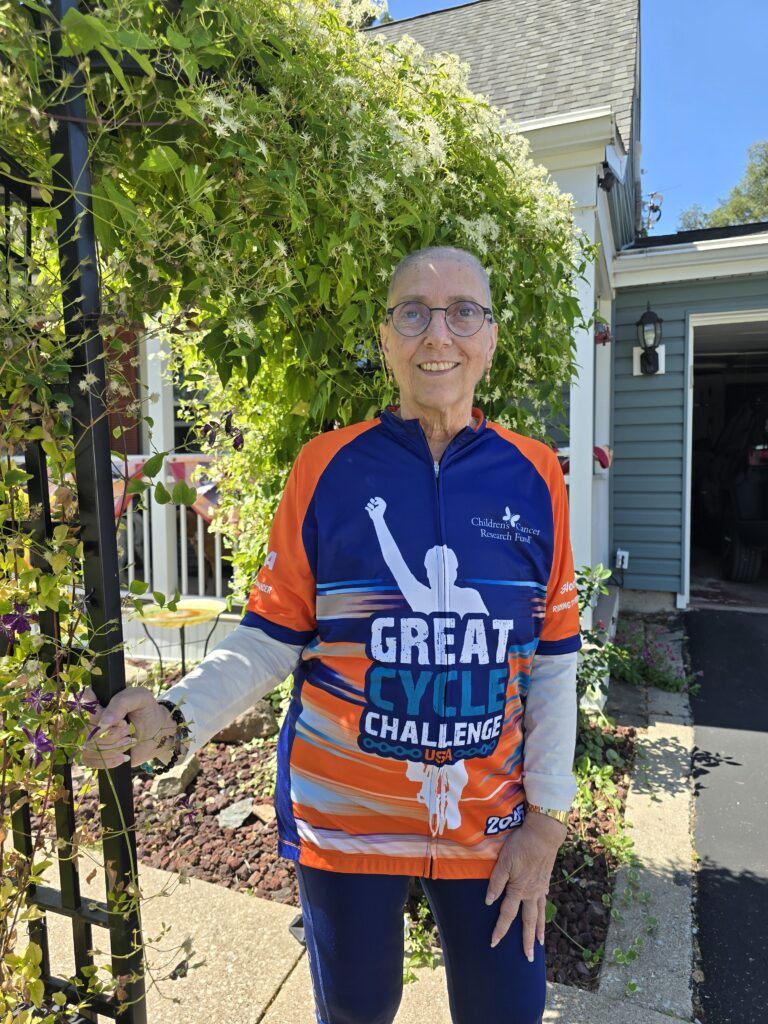
Each September, the Indiana resident participates in the Great Cycle Challenge for Children’s Cancer, setting a 300-mile goal and raising money for pediatric cancer along the way. It’s a cause she cares deeply about, and so much so that she donates $500 of her own every year on her birthday.

I laid in that ER and turned everything over to God. I knew it was out of my control, and I needed someone to be in control. I trust every doctor he puts in my path, but now, if I have a concern, I say something.
Yet, about two years ago, while training for another edition of the challenge, Mary noticed that her usual rides were hitting her much harder than they once did. After most rides, she’d develop intense nausea, and while she’d never been much of a napper, she also found herself passing out for hours after the exertion.
Mary chalked most of her symptoms up to a stomach bug, but when she stepped on the scale and saw that she’d lost 13 pounds in just three weeks, she knew something was amiss.
“I knew that wasn’t right,” Mary said. “I really don’t lose weight.”
Mary told her husband, Don, to take her to urgent care, and the medical team there sent her to the emergency room. A nurse at the ER asked Mary about her most recent bowel movement, and Mary described it as grayish and floating. The nurse added the information to her chart, and Mary later learned that pale stools can accompany a blockage of the bile duct – and be a potential sign of pancreatic cancer.
The ER doctor, however, suspected gastritis. He gave Mary three prescriptions and told her to see her primary care provider if her condition didn’t improve within three days. However, Mary questioned the diagnosis and requested a CAT scan. The doctor pushed back, telling her the scan would take three hours. He also tore up the paperwork urgent care had given her for admission into the ER and told her that her condition would be best handled at urgent care.

Being a Christian, you want to give them grace. But this really made me realize that I’m my own advocate, and I don’t take “no” for an answer anymore. Mistakes happen; I get that – but some can be life or death.
Mary left without the scan, but when her symptoms worsened, she followed the ER doctor’s recommendation and saw her PCP for bloodwork and a CAT scan. After reviewing the bloodwork, the provider sent Mary straight back to the emergency room.
A different doctor treated her this time, and Mary’s granddaughter, Sierra, joined her. As they waited, Sierra noticed something alarming.
“Am I crazy, or is she yellow?” Sierra asked the nurse.
It turned out Mary had developed jaundice, and the CAT scan soon revealed why: a tumor on her pancreas was blocking the flow of bile, causing it to back up into her liver. The doctor diagnosed Mary with pancreatic adenocarcinoma.
By the time Mary reached the hospital for additional care, her skin had become intensely yellow. Her medical team performed an endoscopy, placed a stent to open the bile duct and biopsied the tumor, confirming the cancer diagnosis.
While Mary expressed frustration at how the first ER doctor addressed – or failed to address – her concerns, she came away from the experience with a new perspective on medical care: trusting a doctor doesn’t mean you have to ignore your own instincts.
“Being a Christian, you want to give them grace,” she said, of medical professionals. “But this really made me realize that I’m my own advocate, and I don’t take “no” for an answer anymore. Mistakes happen; I get that – but some can be life or death.”
Mary’s faith remained central throughout her treatment, as did her willingness to speak up when something didn’t feel right.
“I laid in that ER and turned everything over to God,” Mary said. “I knew it was out of my control, and I needed someone to be in control. I trust every doctor he puts in my path, but now, if I have a concern, I say something.”

After Mary’s diagnosis, things moved quickly. Within days, she had an oncologist, surgeon and tumor team in place. She also had a port installed and completed five rounds of FOLFIRINOX before surgery.
Mary entered treatment with the endurance of someone who regularly rode up to 50 miles at a time, prompting her care team to believe her body could handle the strongest dose possible. She managed the first few rounds relatively well, but the treatment eventually took its toll.
“The pump is what did me in,” she said. “I was on that pump for 46 hours.”
The chemo side effects also gave Mary an unusual frame of reference when she had her Whipple procedure in January 2025. After spending a week in the hospital and returning about four weeks later to have her staples removed, Mary’s doctor asked how she’d handled the major surgery.
“It was a piece of cake,” Mary said, much to her doctor’s surprise. He told her he’d never heard anyone describe a Whipple that way. For Mary, though, chemotherapy was much harder.

God’s got me. I know he does, because I don’t think anyone should be doing as well as I am if it wasn’t for Him. He put everybody in place that I needed.
In many ways, Mary has fared well since her surgery. She still has stomach issues, and while doctors want her to eat six small meals each day, she’s usually lucky if she manages three. Mary also avoided developing diabetes, which many people face after pancreatic surgery.
Her overall health status, however, remains complicated. Mary had fatty liver disease before cancer treatment and received a diagnosis of non-alcoholic cirrhosis after her first chemotherapy regimen. The condition has since progressed to Stage 4 liver disease, and Mary takes medications to prevent fluid buildup. She said her previous Whipple surgery rules out the possibility of a liver transplant, making those medications especially critical in managing her liver disease.
While Mary understands the seriousness of her liver disease, she doesn’t want it to overshadow the life she lives now.
“God’s got me,” Mary said. “I know he does, because I don’t think anyone should be doing as well as I am if it wasn’t for Him. He put everybody in place that I needed.”
Mary gained strength from the people around her, including her husband, Don, and granddaughters Sierra and Jadelynn. Her church became another major source of support, even though she and Don had only attended for about four years. Cancer also deepened Mary’s faith to the point that she chose to get baptized this past August. Her faith continues to help her manage a life and future that still holds some uncertainty.
I truly believe now that you’re never guaranteed tomorrow, and I live one day at a time because there may not be a tomorrow. I just do everything I can, and everything I want to do, I do now; I don’t say I’ll do it later.
In one such moment of uncertainty, a PET scan revealed an area that concerned Mary’s doctor. The doctor didn’t necessarily think it was cancer, but he did recommend she have a biopsy to rule it out for sure.
It turned out the concerning area on the scan was actually a stent that was supposed to disintegrate within Mary’s body, but never did. There was also an ulcer at the end of her pancreas that contributed to the PET scan lighting up. The experience taught Mary something she thinks other survivors should know: other conditions, including inflammation, can prompt activity on a PET scan, so an abnormal result shouldn’t immediately raise alarm bells.
Mary also wishes people facing pancreatic cancer would receive more information from their care teams from the outset. She’d like to see doctors do more to connect people with available resources, and she wants patients to hear more about their right to seek a second opinion, the importance of consulting specialists and how to get all the answers they need about their diagnoses and treatment options. Mary hopes her experience will encourage others to trust their instincts, understand their options and advocate for themselves when they need answers.
Her commitment to helping others hasn’t faltered since her own diagnosis, either. She continues to donate $500 to pediatric cancer each year on her birthday and participate in the same Great Cycle Challenge she was preparing for when her symptoms first appeared.
This November, she’ll participate virtually from Indiana in the Seena Magowitz Foundation’s second annual Steppin’ Up Against Pancreatic Cancer event, with the in-person event set to take place at Arizona State University.
Nearly two years after her diagnosis, pancreatic cancer has changed both the way Mary thinks about her own future and how she uses the time in front of her.
“I truly believe now that you’re never guaranteed tomorrow, and I live one day at a time because there may not be a tomorrow,” she said. “I just do everything I can, and everything I want to do, I do now; I don’t say I’ll do it later.”